
Librarian Trading Hall
A librarian trading hall can sell you nearly every enchanted book in the game at a fixed price. Here is how to set up the librarians and reroll them until they offer what you want.
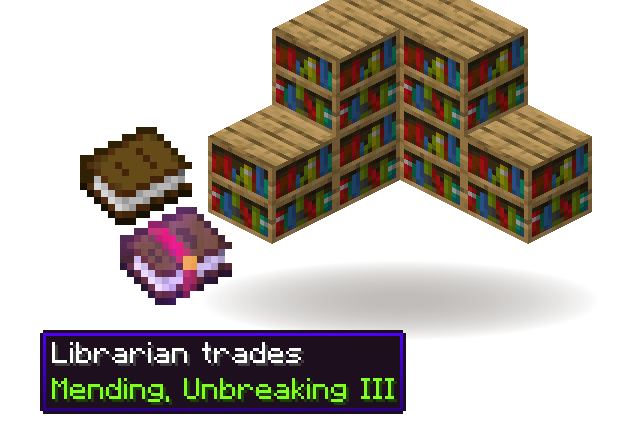
These librarian instructions and prices use default trades with Villager Trade Rebalance disabled. Experimental trades follow different rules.
Make a librarian
Put a lectern next to an unemployed villager. It becomes a librarian and its first trades appear, usually including one enchanted book.
Reroll
If the book is not what you want, break the lectern and put it back. As long as you have never traded with that villager, it picks new trades. Repeat until you see the book you need, then trade once to lock it.
Prices and discounts
Book prices depend on the level and are doubled for treasure enchantments: see the full price list. Curing a zombie villager gives a huge permanent discount; the Hero of the Village effect after a raid gives a temporary one.
The trading hall
Keep each librarian in a small cell with its lectern, where it works and restocks up to twice a day. One librarian per book you buy often is enough: Mending, Unbreaking III, Efficiency V, Protection IV, Sharpness V and Feather Falling IV are the usual set.
Getting emeralds for books
Book trades need a lot of emeralds. Librarians themselves buy paper and books, and farmers buy crops, so a sugar cane farm and a crop farm pay for most books. Fletchers buying sticks and clerics buying rotten flesh are easy extras. Keep a shulker box of emeralds next to the hall and you can buy a full set of books in one visit.
Check the price list to see what each book should cost, and the Mending guide for the most wanted trade.
Getting villagers to your hall
You need unemployed villagers, and you need them in your hall. There are three ways to get them: move them from a village, breed them, or cure zombie villagers. Curing is the best, because cured villagers also give you a big discount.
Moving villagers
- Boats: a villager steps into a boat if you push it in. Boats move on land too, slowly, so they work for short trips.
- Minecarts: for long distances, lay rails from the village to the hall. Push the villager into a minecart on the track.
- Water streams: villagers float along flowing water, which is handy for sorting them into cells.
Leads don't work on villagers in Java, so don't bother crafting one for this.
Breeding villagers
Two villagers breed when they are willing and there is a free bed nearby for the baby. Throw them bread, carrots, potatoes or beetroots to make them willing. The baby grows up in about 20 minutes, and only then can it take a job. A simple breeder near the hall keeps a supply of fresh villagers for rerolling.
A trading hall layout
The common design is a long corridor with a row of small cells on one or both sides. Each cell is one block wide and holds one villager standing in front of its lectern. You stand in the corridor and trade through a gap.
- Cell: a 1×1 space, two blocks tall, for the villager. The lectern sits right behind or beside it, inside the cell.
- Front: a glass block or a trapdoor at head height lets you reach the villager without it walking out.
- Spacing: one lectern per villager, and no spare lecterns anywhere near the hall. A free lectern lets a villager switch jobs before you lock it.
- Safety: light the area well and fully enclose the cells. A zombie that reaches a villager can turn it into a zombie villager, and you lose your locked trades until you cure it.
- Roof: lightning turns a villager into a witch. A solid roof and a lightning rod nearby protect your best traders.
- Reroll cell: keep one empty cell with a lectern next to the breeder. Every new villager goes there first, gets rerolled, and moves on once it has a good book.
Villagers restock when they can reach their lectern during the working day, up to twice a day. They don't need a bed to restock, but beds are needed for breeding.
Rerolling quickly
Rerolling is the slow part, so make each attempt fast. Hold an axe, ideally with Efficiency, to break the lectern in a moment. Break it, wait until the villager's librarian outfit disappears, then place the lectern again. The new trades show up once the villager claims it, which green sparkles confirm.
A new librarian usually shows two trades, picked from buying paper, selling bookshelves and selling an enchanted book. So often there is no book at all, and you just reroll again. When a book does appear, its level is random, up to that enchantment's max. So a top-level book takes more rerolls than a book of any level.
Also look at the price. The same book can cost anywhere in its range: for Mending that is 10–38 emeralds. A few extra rerolls for a cheap price save a lot of emeralds over hundreds of trades. Then trade once to lock it in.
Buying low levels and merging
Sometimes a lower level shows up first. Two Sharpness IV books from a librarian cost 14–58 emeralds each and merge into Sharpness V for 5 levels. A Sharpness V book costs 17–64 emeralds. So if you see a cheap level IV, buying two can beat waiting for a V. But the merged book carries a small anvil penalty, so a direct V is best when it comes up.
Which books to lock
Each librarian you lock is one book you can buy forever. Here are the books worth a librarian, with the price range for the top level.
| Book | Used on | Emeralds at max level |
|---|---|---|
| Mending | every piece of gear | 10–38 |
| Unbreaking III | every piece of gear | 11–45 |
| Protection IV | all four armor pieces | 14–58 |
| Efficiency V | pickaxe, axe, shovel and shears | 17–64 |
| Sharpness V | sword, axe and spear | 17–64 |
| Feather Falling IV | boots | 14–58 |
| Fortune III | pickaxe for ores | 11–45 |
| Silk Touch | second pickaxe | 5–19 |
| Looting III | sword and spear | 11–45 |
| Power V | bow | 17–64 |
| Depth Strider III | boots | 11–45 |
| Respiration III | helmet | 11–45 |
| Aqua Affinity | helmet | 5–19 |
| Thorns III | armor | 11–45 |
| Sweeping Edge III | sword | 11–45 |
| Density V | mace | 17–64 |
| Frost Walker II | travel boots | 16–64 |
Start with the first six, because they go on almost every build. Then add the rest as your projects need them. For bigger builds like the god armor set, you need four Protection IV books at once, so a librarian that sells it saves a lot of table rolls. Swift Sneak, Soul Speed and Wind Burst are the only ones no librarian sells.
Let a good librarian level up
Every trade gives the villager experience. As it levels up, it unlocks new trades, and those can include more enchanted books. So one librarian can end up selling several different books. Keep trading with your best ones, and check their new offers after each level.
Curing zombie villagers for discounts
Curing gives the largest discount in the game. The player who cures the villager gets the biggest drop, and it stays for good.
- Trap a zombie villager in a shaded cell, because it burns in daylight.
- Throw a splash potion of Weakness on it. Brew it from a water bottle and a fermented spider eye, then add gunpowder.
- Feed it a golden apple, the normal kind, while it has Weakness. It starts shaking and gives off red particles.
- Wait. The cure takes a few minutes. Keep it in the dark and safe from other zombies.
- Give it a lectern once it is a villager again. A cured villager that had already traded keeps its old trades.
On Hard difficulty, a zombie that kills a villager always turns it into a zombie villager. Many players use this on purpose. They let a zombie reach a locked librarian, then cure it to cut the prices. On Normal, the villager only converts some of the time, and on Easy it just dies. So switch to Hard before you try it.
What changes prices
- Curing: a big permanent drop for the player who cured it.
- Hero of the Village: winning a raid lowers prices with every villager in that village for a while.
- Trading often: regular trades slowly build your reputation, so the librarians you use most get a little cheaper over time.
- Other players: discounts from curing belong to the player who cured the villager, so on a server each player sees different prices.
- Demand: if you buy out a trade every day, its price rises after the next restock. Spread your buying over several librarians.
- Hitting villagers: attacking a villager raises its prices for you.
For the full range of every book, see the villager enchantment price list.
Common trading hall mistakes
- Trading before you check. A single trade locks the librarian. Even a paper trade counts.
- Spare lecterns nearby. The villager may claim a different lectern, so your reroll does not happen.
- Trying to reroll a nitwit. Villagers in green coats never take a job. Use them for breeding instead.
- Forgetting the plain book. Every enchanted book trade also asks for one ordinary book, so keep a stack of them.
- No lighting. One zombie in the hall can undo hours of rerolling.
- Buying every enchantment. Common books like Efficiency come cheaply from the enchanting table too. Use librarians for the books the table can't give at max level.
When the books arrive, put them together in the cheapest order with the enchantment calculator.
Emerald budget for god armor
Here is what a full set of max armor costs from librarians at normal prices. It needs 20 books: four each of Mending, Protection IV, Unbreaking III and Thorns III, plus Feather Falling IV, Depth Strider III, Respiration III and Aqua Affinity.
That comes to between 225 and 911 emeralds before discounts, plus 20 plain books. Swift Sneak and Soul Speed are not included, because no librarian sells them. With cured librarians, the same set can cost a small fraction of that.
So a big trading hall needs an emerald income. Farmers, fletchers, clerics and librarians themselves all buy cheap items for emeralds, and those trades also level them up. See the god armor page for the full build.
Building a ten-cell hall step by step
- Dig or build a corridor 3 blocks wide and 12 blocks long, with a solid roof.
- Mark ten cells along one wall, each one block wide and two blocks tall, with a block wall between them.
- Place one lectern in the back of each cell, so the villager stands between you and its lectern.
- Close each front with a trapdoor or a glass block at head height, leaving a gap to click through.
- Light the whole hall so no mobs spawn inside, and add a lightning rod on the roof.
- Bring villagers in one at a time with a minecart or a water stream, then close the cell behind them.
- Reroll each one until it sells a book you want, then trade once.
Ten cells cover all the common books. Add more cells later for less common books, like Looting, Power or Lunge, as your builds grow.
Protecting your hall from raids
A trading hall full of villagers counts as a village. So if you walk in with the Bad Omen effect, a raid can start right on top of your librarians. Before you head home, drink milk to clear Bad Omen, or simply wait for it to wear off far away.
If a raid does start, keep the villagers sealed in their cells. Pillagers and ravagers can't reach villagers that are fully enclosed. Winning the raid then gives you Hero of the Village, which is a nice bonus for your next shopping trip.
Checking a hall after a long break
When you come back to an old hall, check each librarian before you trade. Look for zombie villagers that got in, villagers that left their cells, and lecterns that someone moved. A villager that lost its lectern still keeps its locked trades, but it can't restock until it can reach a lectern again. Place a new one in its cell and wait for the green sparkles.
Also check the prices. If you bought out the same trades every day before your break, demand may have pushed them up. They drift back down over a few restocks once you stop buying so much. Meanwhile, buy from your other librarians instead, so no single trade gets too expensive.
Questions
Can librarians sell every enchantment?
No. Soul Speed, Swift Sneak and Wind Burst can't be bought.
Why can't I reroll my librarian anymore?
Once you trade with a villager, its trades are locked for good.
Do villagers need beds to restock?
No. They restock at their lectern during the working day. Beds matter for breeding.
How long does it take to cure a zombie villager?
A few minutes, usually between three and five in Java. Keep it out of sunlight while it shakes.
Can you move a librarian after trading?
Yes. It keeps its locked trades. Give it a lectern in the new place so it can restock.
Why won't my villager take the lectern?
It may be a nitwit, a baby, or it may already have a job. Another free lectern nearby can also draw it away.
Can librarians sell max level books?
Yes. The level is random up to the max, so a top-level book just takes more rerolls.